BLACK HISTORY TEACHINGS
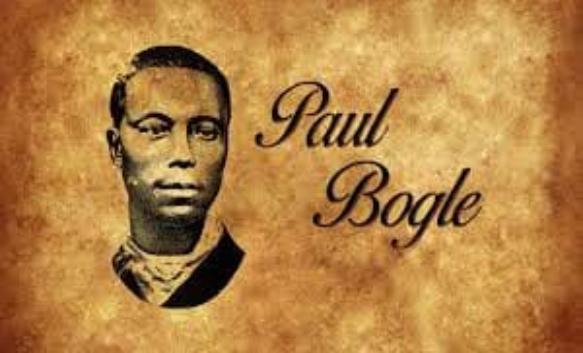
Paul Bogle
(1820 – 24 October 1865) was a Jamaican Baptist deacon and activist. He is a National Hero of
Jamaica.
He was a leader of the 1865 Morant Bay protesters, who marched for justice and fair treatment
for all the people in Jamaica.
After leading the Morant Bay rebellion, Bogle was captured by government troops, tried and
convicted by British authorities under martial law, and hanged on 24 October 1865 in the
Morant Bay court house.
Bogle had become a friend of wealthy landowner and fellow Baptist George William Gordon, a
bi-racial man who served in the Assembly as one of two representatives from St. Thomas-in-
the-East parish.
Gordon was instrumental in Bogle being appointed deacon of Stony Gut Baptist Church in
1864. Conditions were hard for black peasants, due to social discrimination, flooding and crop
failure, and epidemics.
The required payment of poll taxes prevented most of them from voting. In August 1865,
Gordon criticised the British governor, Edward John Eyre, for sanctioning "everything done by
the higher class to the oppression of the negroes".
Bogle concentrated on improving the conditions of the poor.
As awareness of social injustices and people's grievances grew, Bogle led a group of small
farmers 45 miles to the capital, Spanish Town, hoping to meet with Governor Eyre to discuss
their issues, but they were denied an audience.
The people of Stony Gut lost confidence and trust in the Government, and Bogle’s supporters
grew in number in the parish.
The Morant Bay rebellion
11 October 1865 began with a protest march to the courthouse by hundreds of people led by
preacher Paul Bogle in Morant Bay, Jamaica. Some were armed with sticks and stones. After
seven men were shot and killed by the volunteer militia, the protesters attacked and burned
the court house and nearby buildings. A total of 25 people died. Over the next two days,
peasants rose up across St. Thomas-in-the-East parish and controlled most of the area.
The Jamaicans were protesting injustice and widespread poverty.
Most freedmen were prevented from voting by high poll taxes, and their living conditions had
worsened following crop damage by
floods, cholera and smallpox epidemics, and a long drought. A few days before, when police
tried to arrest a man for disrupting a trial, a fight broke out against them by spectators. Officials
had issued a warrant for the arrest of preacher Bogle.
Governor Edward John Eyre declared martial law in the area, ordering in troops to hunt down
the rebels. They killed many innocent black individuals, including women and children, with an
initial death toll of more than 400. Troops arrested more than 300 persons, including Bogle.
Many of these were also innocent but were quickly tried and executed under martial law; both
men and women were punished by whipping and long sentences. This was the most severe
suppression of unrest in the history of the British West Indies.
The governor had George William Gordon, a mixed-race representative of the parish in the
Assembly, arrested in Kingston and brought back to Morant Bay, where he tried the politician
under martial law. Gordon was quickly convicted and executed.
The violent suppression and numerous executions generated a fierce debate in England, with
some protesting about the unconstitutional actions of the governor John Eyre, and others
praising him for his response to a crisis. The rebellion and its suppression remain
controversial, and it is frequently debated by specialists in black and colonial studies. — with
Lupita Natty Dread, Ras Mackab, Serena Tafari, Rasta Popo, Dread Reykon Ztr Vds, Jamaica
Dread, Jamaica Digest and Royal Empresses.
Source: Daniel Watson ~ FB post ~ 3 Oct 2019
|