|
|
All Things Africana!
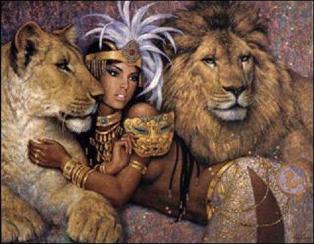
In the book The Adventures of Esplandián by Spanish writer Garci Rodríguez de
Montalvo in the 1500s, after many pages of battles and adventures, the story of Calafia is
introduced as a regal Black Amazonian warrior queen who ruled over a kingdom of Black
women living on the mythical Island of California. She was portrayed as courageous,
strong of limb and large of person, full in the bloom of womanhood, the most beautiful of
a long line of queens who ruled over the mythical realm. She is said to be "desirous of
achieving great things"; she wanted to see the world and plunder a portion of it with
superior fighting ability, using her army of women warriors. She commanded a fleet of
ships with which she demanded tribute from surrounding lands, and she kept an aerial
defense force of griffins, fabulous animals which were native to California, trained to kill
any man they found.
In the novel, Calafia is a pagan who is convinced to raise an army of women warriors and
sail away from California with a large flock of trained griffins so that she can join a
Muslim battle against Christians who are defending Constantinople. In the siege, the
griffins harm enemy and friendly forces, so they are withdrawn. Calafia and her ally
Radiaro fight in single combat against the Christian leaders, a king and his son the knight
Esplandián. Calafia is bested and taken prisoner, and she converts to Christianity. She
marries a cousin of Esplandián and returns with her army to California for further
adventures.
The name of Calafia was likely formed from the Arabic word khalifa (religious state
leader) which is known as caliph in English and califa in Spanish. Similarly, the name of
Calafia's monarchy, California, likely originated from the same root, fabricated by the
author to remind the 16th-century Spanish reader of the reconquista, a centuries-long
fight between Christians and Muslims which had recently concluded in Spain.
Calafia has been depicted as the Spirit of California, and has been the subject of
modern-day sculpture, paintings, stories and films; she often figures in the myth of
California's origin, symbolizing an untamed and bountiful land prior to Europeans taking
the land by force.
Source: Alexi Falk ~ FB Post 11-01-2017
|
|
|
Queen Kahina of Algeria/Mauritania
In 639 AD a new conquering force swept into Africa. The Arabians seized Egypt,
Cyrenaica (eastern Libya), Tripoli, and pushed on to Carthage (mainly Tunisia) and
Numidia (Algeria and Tunisia). The invasion swept away 600 years of Roman occupation
bringing an end to the Byzantine Empire. The new conquerors spread Islam from Egypt
to Morocco and also into Spain. The Spanish conquest was achieved with African help
but the invaders also destroyed many Africans, enslaved many, and caused others to flee
further south to evade their clutches. Kuseila of Mauritania resisted but he was defeated
and killed in 688 AD. Dahia al-Kahina (cf. Cohen) a Berber woman of the Jerawa tribe
became leader of the African resistance. She is generally held to have been a Jewess but
we believe that she could just as well have followed the old Carthaginian religion which
differs from Judaism but also shares some affinities with it.
Arab records describe her as having “dark skin, a mass of hair and huge eyes”, more than
likely her hair being styled in locs. Dr John Clarke describes her as a nationalist who
favoured no particular religion. This may explain her effectiveness in bringing together a
united front against the invaders. She counterattacked the invaders and drove them into
Tripolitania. This was so effective that some Arabs doubted whether Africa could be
taken. As one African army was beaten another replaced them. The Arabs seized
Carthage in 698 AD. Dahia defeated them and instituted a scorched earth policy to
prevent the Arabs from being able to find crops to feed on in the region. That desolation
can be seen even today in southern Tunisia. Eventually, however, the Arabs returned.
Dahia was finally defeated in battle in 705 AD and North Africa was overrun. Eventually
this defeat would lead to the Arab conquest in Spain in 711 AD.
(Below: Artist depiction of Queen Kahina)
Source: Alexi Falk ~ FB Post 11-01-2017
|
|
|
Tituba: First of the Salem Witch Trials
Tituba was a West Indian woman who became slave to Samuel Parris of Massachusetts.
She was born of an Arawak village in South America before being stolen and taken to
Barbados, later to be sold as a slave and sent to Boston in 1680.
Tituba became the first person to be accused of witchcraft by the daughters of Samuel
Parris, alleging she practiced voodoo and taught Salem Village girls fortune telling. The
girls accused her of putting a hex on them. At first she denied the accusations against her
but she was beaten into confession by Samuel Parris. She admitted to participating in
occult techniques she learned but assured it was only to ward herself from evil. To save
herself Tituba and her husband John helped a neighbor named Mary Sibley bake a witch
cake, a cake made from rye meal and the afflicted girl’s urine, and fed it to a dog hoping it
would reveal the name of whoever bewitched the girls.
When the girls’ afflictions grew worse, Tituba was arrested. Her various confessions of
seeing certain individuals possessing creatures also led to two other women (Sara
Osborn and Sara Good) being taken into custody. With this event sparked a massive
witch hunt. Unintentionally, Tituba set Salem Village into a chaos by hinting that Satan
was among them.
Since Tituba confessed, her case never went to trial and she was spared the gallows. On
May 9, 1692, a grand jury in Ipswich declined to indict Tituba, writing “ignoramus” on
her paperwork indicating she was found not guilty due to a lack of evidence. Despite this,
Tituba remained in jail in Boston because Parris refused to pay her jail fees. It is possible
he wanted to be rid of her because she served as a reminder of the witch trials or
because he was angry at her for recanting her confession. In April of 1693, Tituba was
sold to an unknown person for the price of her jail fees. It is also assumed her husband
was sold along with her. It is not known what happened to Tituba or John after they
were sold that day.
Source: Alexi Falk ~ FB Post 11-01-2017
|
|
|
All Things Africana
Who’s ever heard of the term: PLACAGE?
America (including the Caribbean) by which ethnic European men entered into the
Placage was a recognized extralegal system in French and Spanish colonies of North
equivalent of common-law marriages with “women of color” (African, Indigenous
American and “mixed”-race women). The term comes from the French word placer
which means “to place with”. The women were not legally recognized as wives but were
known as placees; their relationships were recognized among the free people of color as
marriages de la main gauche or left-handed marriages. They became institutionalized
with contracts or negotiations that settled property on the woman and her children, and
in some cases gave them freedom if enslaved. The system flourished throughout the
French and Spanish colonial periods, reaching its zenith during the latter, between 1769
and 1803. This system greatly affected how areas such as New Orleans and in the
Caribbean became full of “mixed-race” families within the colonies compared to the
British and Dutch colonies.
Source: Alexi Falk ~ FB Post 11-01-2017
|
|
|
YENNENGA: Princess of Dagomba and mother of the Mossi People of Burkina Faso
Yennenga was the daughter of Nedega, an early 12th-century king of the Dagomba
Kingdom in what is now northern Ghana. She's described as a beautiful and beloved
princess who from the age of 14, fought in battle for her father against the neighboring
Malinkés. Skilled with javelins, spears and bows, she was an excellent horsewoman and
commanded her own battalion. Yennenga was such an important fighter that when she
reached a marriageable age, her father refused to choose a husband for her or allow her
to marry.
One of the king's horsemen helped Yennenga, dressed as a man, escape on her stallion.
Attacked by Malinkés, her companion was killed, and Yennenga was left alone. She
continued to ride north until one night when she was exhausted from crossing a river,
Yennenga's stallion took her into a forest. She met a solitary elephant hunter called Riale
and when he saw through Yennenga's disguise, they fell in love. Yennenga and Riale had
a son they named Ouedraogo, which means "stallion" and is now a common name in
Burkina Faso. Ouedraogo founded the Mossi Kingdom. Today she is considered the
mother of the Mossi peoples of Burkina Faso.
Source: Alexi Falk ~ FB Post 11-01-2017
|
|
|
All Things Africana
Did you know that cornrows in African history have been used as maps? During the
transatlantic slave trade in the Americas, African slaves would use this method of hair
braiding to illustrate escape routes from the plantation. The braids would either map out
the plantation grounds OR would represent a constellation in the sky to command the
direction in which to escape.
Source: Alexi Falk ~ FB Post 11-01-2017
|
|
|
“The Aurignacians found the Moustierian or Neander-thaler in France, and during all the
changes sketched above, the former seem to have held their own in that country. After
the Wurm Ice Age the Aurignacians modified their weapons and mode of life, and, after
the theory which we have adopted, became the men of La Madeleine.
These Aurignacians and their Magdalenian descendants pervaded all Central and
Southern Europe. Their remains have also been discovered in Valetta (Malta), in
Phoenicia (Nahr Antelias), and elsewhere, as we shall try to show later. But during this
long period of time two other races also succeeded in entering France and Italy. These
were a “ negroid,” perhaps pygmy, folk and the men of Solutrean.
We have seen that the Aurignacian was originally an African, and if he traversed North
Africa on his way from Egypt and Mesopotamia, it would have been a very remarkable
fact if he had not come in contact with the African pygmy or his ancestors, for the
Bushman, Wam-battu, and the other pygmies are the oldest African race known to us.
The “ negroids ” discovered by Dr. Verneau in the Grotte du Grimaldi, though differing
greatly from modern Bushmen, show that the Aurignacians were acquainted with a
negroid stock, which may perhaps be assumed to be an ancestor of, or allied to, the
pygmy. It is difficult to say exactly what was the relation between the Aurignacian and
this “ negroid ” race.”
-PREHISTORIC MAN AND HIS STORY By Professor G. F. SCOTT ELLIOT, M.A., B.Sc., F.L.S.,
F.R.G.S. Published 1915
Pictured: (Left) Fertility sculpture from Anatolia circa 6,000 to 5,000 BCE. (Right)
Khoisan woman, South Africa early 1900s
Source: Alexi Falk ~ FB Post 11-01-2017
|
| |
|
| |
|
| |
|
|